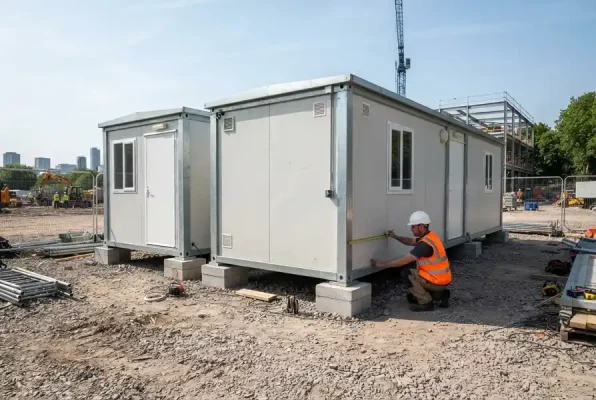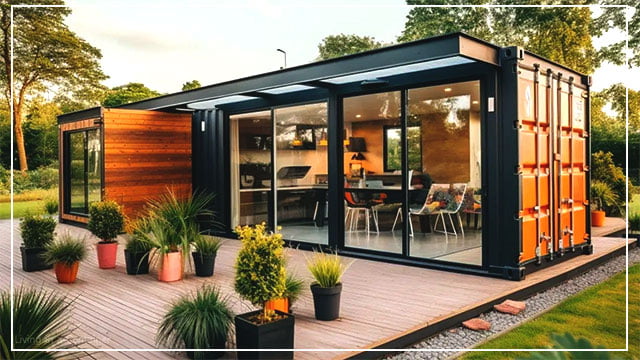

The low-loader is at the site gate, the crane is set up and the slings are on. Then one of the crane’s outriggers starts sinking into ground that was soaked by last night’s rain. The haulier’s waiting time is ticking over, and the container is still on the trailer.
We see versions of this more often than you might think. It is rarely the container that causes the delay. It is that nobody sat down beforehand and talked through the ground, the dimensions, the permits and the order in which the units come off.
This guide follows a modular container from our factory gate to the moment it is ready to use on site: getting it ready, checking the ground, choosing the vehicle and crane, permits, securing the load, unloading and the final checks.

In short: an assembled container travels on a standard flatbed or a low-loader and is lifted off on site by crane, using the lifting points on the top frame. Our 2.40 m wide units stay within normal road width limits. The 3.00 m wide units travel as a wide load with a permit. Flat pack units are shipped as bundles and bolted together on site.
Getting each type of container ready
From the outside they all look like the same box, but what is inside changes the risks on the road. It is worth going through the units one by one and making a short checklist for each type.
Site and project offices
With offices, the risk is furniture and electrics. Anything left loose, such as cupboards, desks or the indoor unit of an air conditioner, will move about in transit. Pack furniture separately or fix it to the wall, and close and tape the cover of the distribution board.
If you are moving an office building made of several modules, number them before loading. If no one on site knows which module goes where, the crane ends up standing idle.
Dining halls
Commercial kitchen equipment is heavy and shifts the centre of gravity. Where you can, send cookers, fridges and dishwashers separately and install them once the serving line is in place. If they have to travel inside, fix them to the floor and include their weight in the lift plan.
Accommodation units
Bunk beds and lockers are usually fixed, so the real issue is numbers. On a large camp, dozens of accommodation units can arrive in the same week. Here the delivery sequence matters more than preparing each unit: bring in the modules for the back of the camp first and leave the ones near the entrance until last.
Toilet and shower units
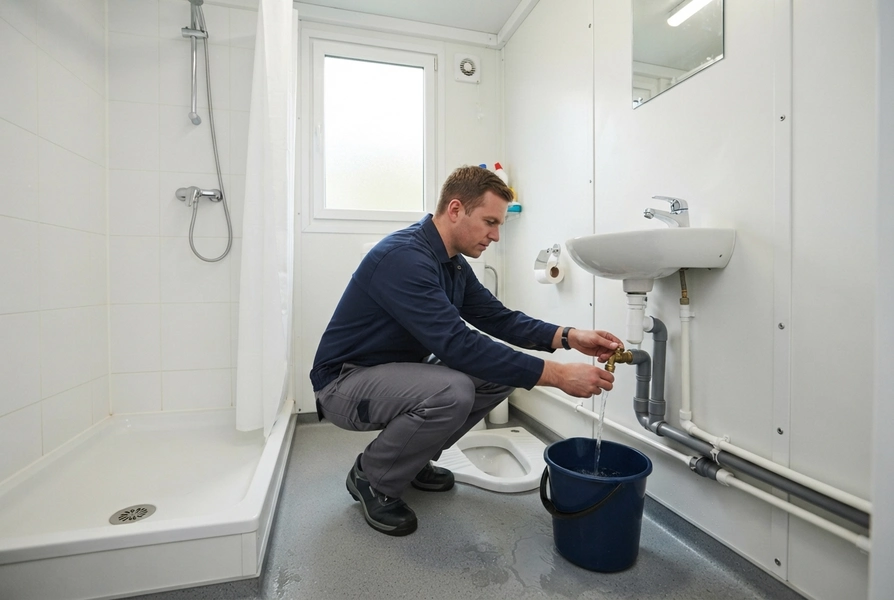
A new toilet and shower unit leaves the factory with no water in the system. Moving a used one is a different matter:
- Drain the cold water pipework, traps and water heater completely. Water left in the pipes can freeze and split them in winter.
- Check the toilet and washbasin connections. Anything loose will shake free on the road.
- Cap the waste outlets to keep dust and insects out and make the connection on site cleaner.
Check the ground and access first
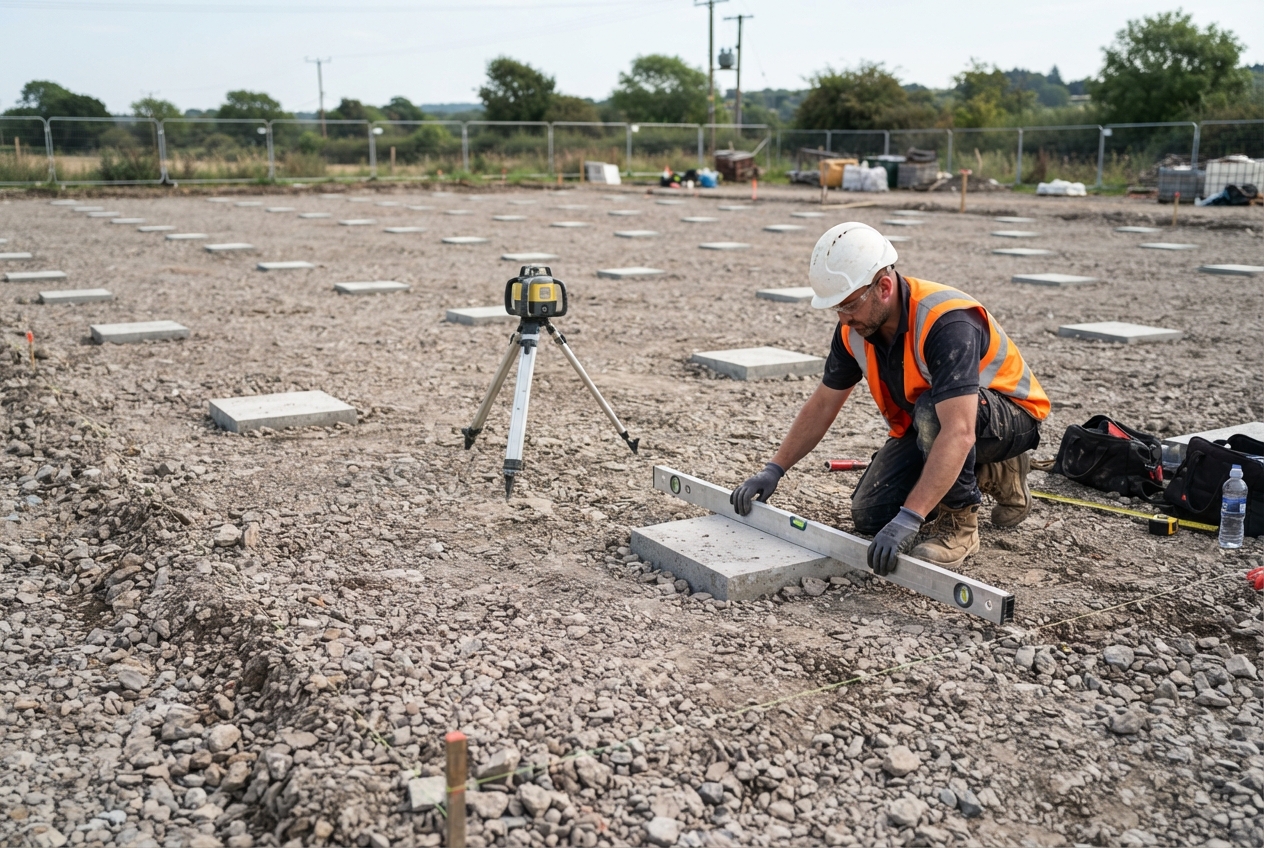
The hold-up we see most on site has nothing to do with the container. It is about where the crane will stand. A container can go almost anywhere, but the lorry and the crane can only get in if the ground lets them.
Before the units leave the factory, you should be able to answer four questions:
- Can the lorry get in? Look at the turning space, gate width, gradient and any overhead power lines.
- Where will the crane outriggers go? Fresh fill, ground that turns to mud after rain and anything over a buried drain are all risky.
- What will the container stand on? Concrete footings, a blinding slab, compacted gravel or a steel platform. Whatever it is, the foundations should be finished before delivery day.
- Where will the water go? Rainwater from the roof runs down through holes in the top frame, so make sure it doesn’t collect around the base.
Check the levels of the footings before delivery day. If they are a few centimetres out, you will spend hours on site packing them up, and the doors and windows will start to stick later.
Choosing the vehicle and crane
To pick the right vehicle, start with the size and weight of the container. For our standard units:
| Unit | External size (W × L × H) | Approx. weight | Transport |
|---|---|---|---|
| 240×600 | 2.40 × 5.98 × 2.50 m | about 1,150 kg | Within the normal width limit |
| 300×700 | 3.00 × 7.00 × 2.50 m | about 1,450 kg | Wide load: over 2.55 m, needs a permit |
| Flat pack | Shipped as bundles | Depends on the model | Bundles are stacked and bolted together on site |
Which vehicle?
- A standard flatbed is fine for a single unit of standard size. The total height gets close to the 4 m limit, though, so check bridges and underpasses on the route.
- A low-loader gives you more headroom because the deck sits lower. It is the usual choice for wide units and routes with low bridges.
- A lorry-mounted crane can unload a single unit on an easy site without hiring a separate crane, as long as its reach is enough.
Why the crane’s tonnage can mislead you
Because the container weighs under 1.5 tonnes, it is tempting to think a small crane will do. But a crane’s capacity drops quickly as the boom extends. If the container has to be placed 15 metres from where the crane stands, what matters is the capacity at 15 metres, not the headline figure in the brochure.
So don’t just tell the crane company “it’s a 1,450 kg container”. Give them:
- the weight and size of the container;
- the distance between where the crane will stand and where the container will be placed;
- anything in the way, such as buildings, trees or power lines.
Lifting points
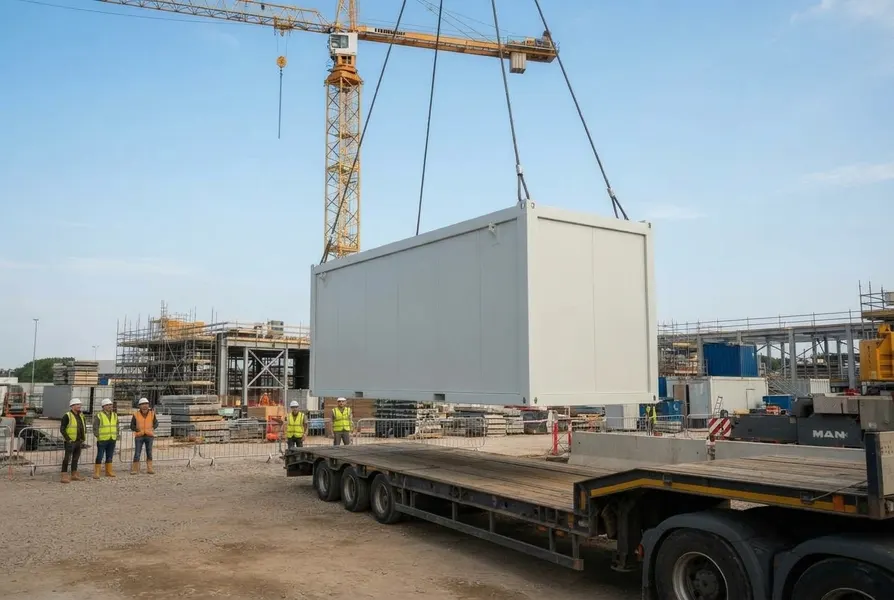
Only lift the container from the lifting points shown at handover, normally the four corners of the top frame. All four slings should take an equal share of the load, and the angle between them shouldn’t be too wide, or the sideways force will strain the frame. On longer units, a spreader beam is the safest option.
Road permits and route planning
In Türkiye and across the European Union, a vehicle and its load may be no more than 2.55 m wide. Most other countries have a similar limit. An indivisible load that is wider than this travels as an abnormal load, with a permit from the road authority.
- Our 240×600 units are 2.40 m wide, so no permit is needed for width as long as height and weight are within limits.
- Our 300×700 units are 3.00 m wide and need a permit. The haulier applies for it, but allow time for it in your programme.
- Many towns and cities restrict lorry movements at certain times. A city-centre delivery may have to arrive early in the morning or at night.
- The haulier should check low bridges, underpasses and tight bends on the route in advance. You know the last few kilometres to your site better than anyone, so tell them about anything unusual.

If permits or access are a problem, look at flat pack containers. They arrive as bundles that fit on standard lorries, and the parts can even be carried by hand into tight sites.
Loading and securing the load
With our standard quotation, we load the containers onto your vehicle at the factory; transport, insurance and the crane on site are arranged by the buyer. On turnkey projects we plan the delivery and connections ourselves. Either way, the rules on the road are the same:
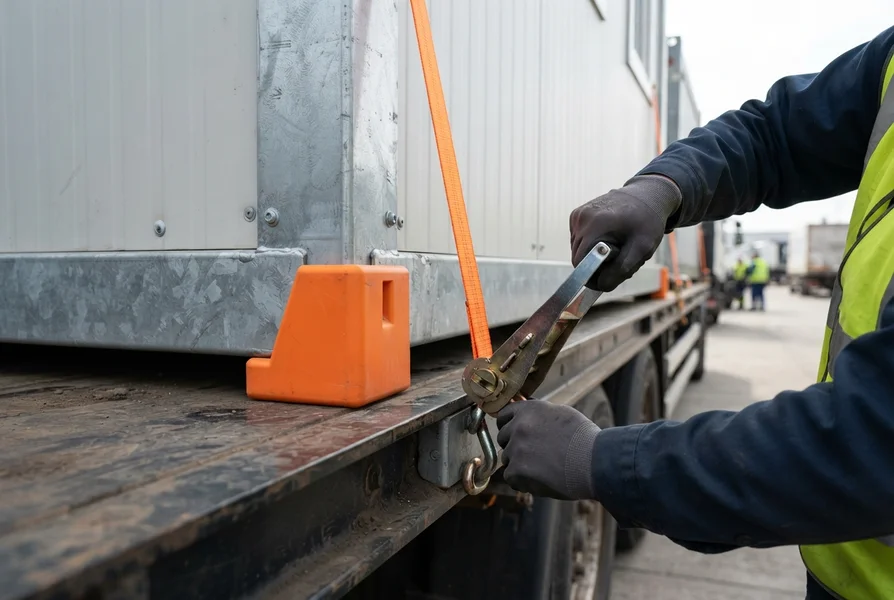
- Secure the container to the trailer at four points or more, with ratchet straps or chains. Straps should bear on the frame, not on the edge of the panels.
- Use corner protectors wherever a strap touches the cladding, or it will damage the paint.
- Lock the doors and windows, and tape them from outside if needed.
- Cover the vents on wet rooms and any other open vents against rain.
- Check before loading that the transit insurance covers the full value of the container.
Unloading and setting up on site
Delivery day is when the preparation pays off. A well-run lift usually goes like this:
- Keep everyone out of the crane’s slewing area, and have one person giving signals.
- Watch the wind. The side of a container acts like a sail, so postpone the lift if it gets too strong.
- Use tag lines to guide the container. Nobody should try to turn it by hand.
- Once the unit is sitting on its footings, check the level before the slings are taken off. That is the easiest moment to adjust it.
Buildings made of several modules
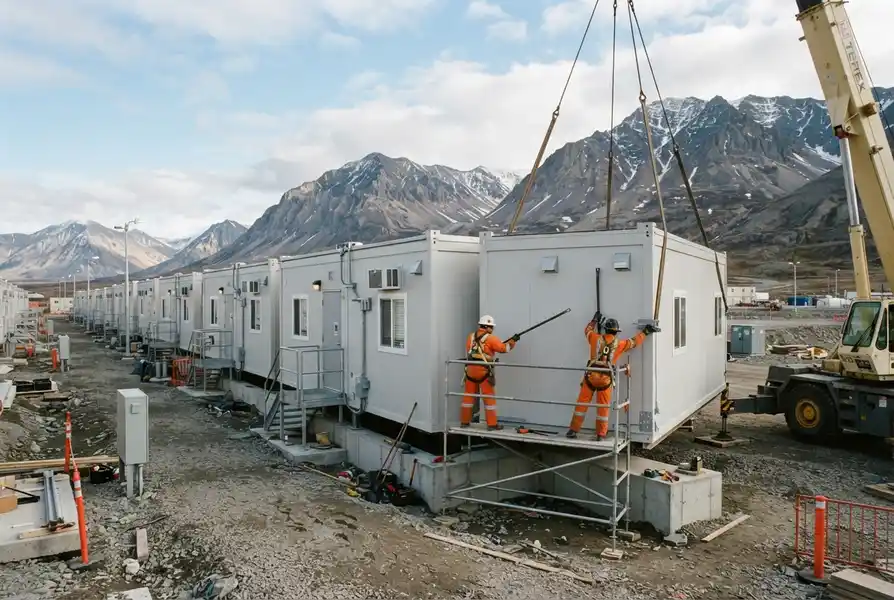
Where office modules or accommodation units are joined side by side, the joints between them must be sealed, or they will leak the first time it rains. Unload the modules in their numbered order, with the joining faces towards each other, and don’t start any internal work until the joints are sealed.
The same goes for dining halls made of several units. The kitchen and serving modules go in first, and the hall modules are lined up against them.
Connecting toilet and shower units
Toilet and shower units need more connections on site than any other module. Water comes in through PPR pipes and waste goes out through PVC. How they connect to the mains and drainage depends on the site. Work out the fall on the waste pipe before the unit goes onto its footings, because changing it afterwards is very difficult.
Checks before the lorry leaves
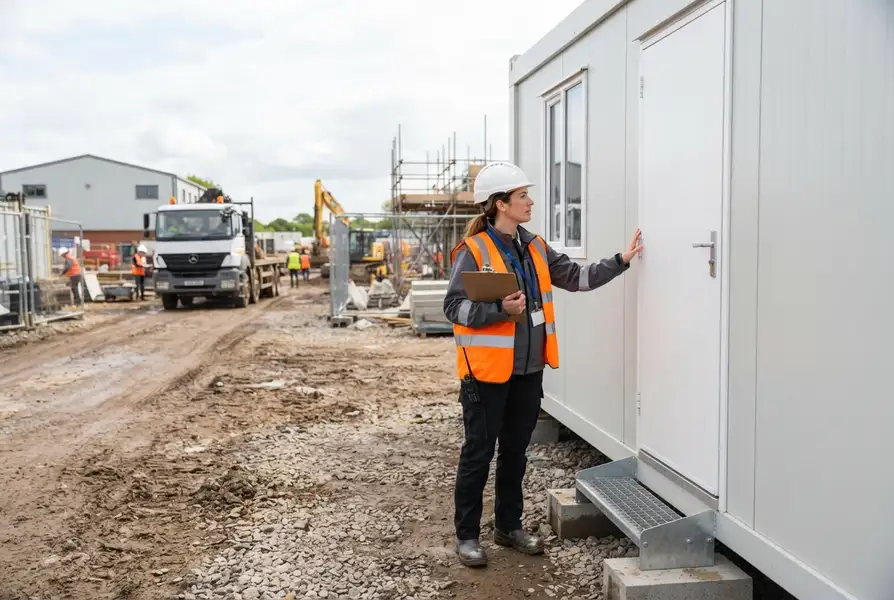
Go through these before the haulier drives off. Any damage needs to be noted on the delivery note now, not later:
- Any dents, scratches or damage to the coating on the outside panels?
- Do the doors and windows open and close without catching? If they stick, the footings are usually out of level.
- Any cracked glass?
- Once the power is connected, does the RCD trip when you press the test button?
- In toilet and shower units, any leaks when the water is turned on? Do the wastes drain properly?
- Any gaps on the roof or at the joints? Look at the ceiling again after the first rain.
Talk to us about delivery when you ask for a quote
Most transport problems can be sorted out before the contract is signed. When you ask for a quote, tell us where the site is, what the access is like and what the ground is like. We will then help you choose the right units and decide whether they should travel assembled or flat packed, in Türkiye or abroad.
Frequently asked questions
What size are office containers when they are transported?
Our standard office containers travel assembled, at 2.40 × 5.98 m or 3.00 × 7.00 m, and 2.50 m high. The 3 m wide unit is over the normal width limit, so it travels as a wide load with a permit. Flat pack units are shipped as bundles.
Do you need to drain a toilet and shower container before moving it?
Yes, if it has been in use. Drain the water pipework, traps and water heater completely and cap the waste outlets. New units leave the factory with no water in the system.
How many accommodation containers fit on one lorry?
Assembled units usually travel one per lorry, depending on their size and the vehicle. For large camps, flat pack units are more efficient because several fit on one vehicle.
What size crane do I need to unload a container?
Our containers weigh between about 1,150 and 1,450 kg, but a crane’s capacity falls as its reach increases. Give the crane company the weight, the distance from the crane to where the container will sit, and any obstructions, and they can choose the right machine.
Are transport and the crane included in your price?
Not in our standard quotation: we load the containers onto your vehicle at the factory, and transport, insurance, the crane and ground preparation are arranged by the buyer. On turnkey projects, delivery and connections are included.