
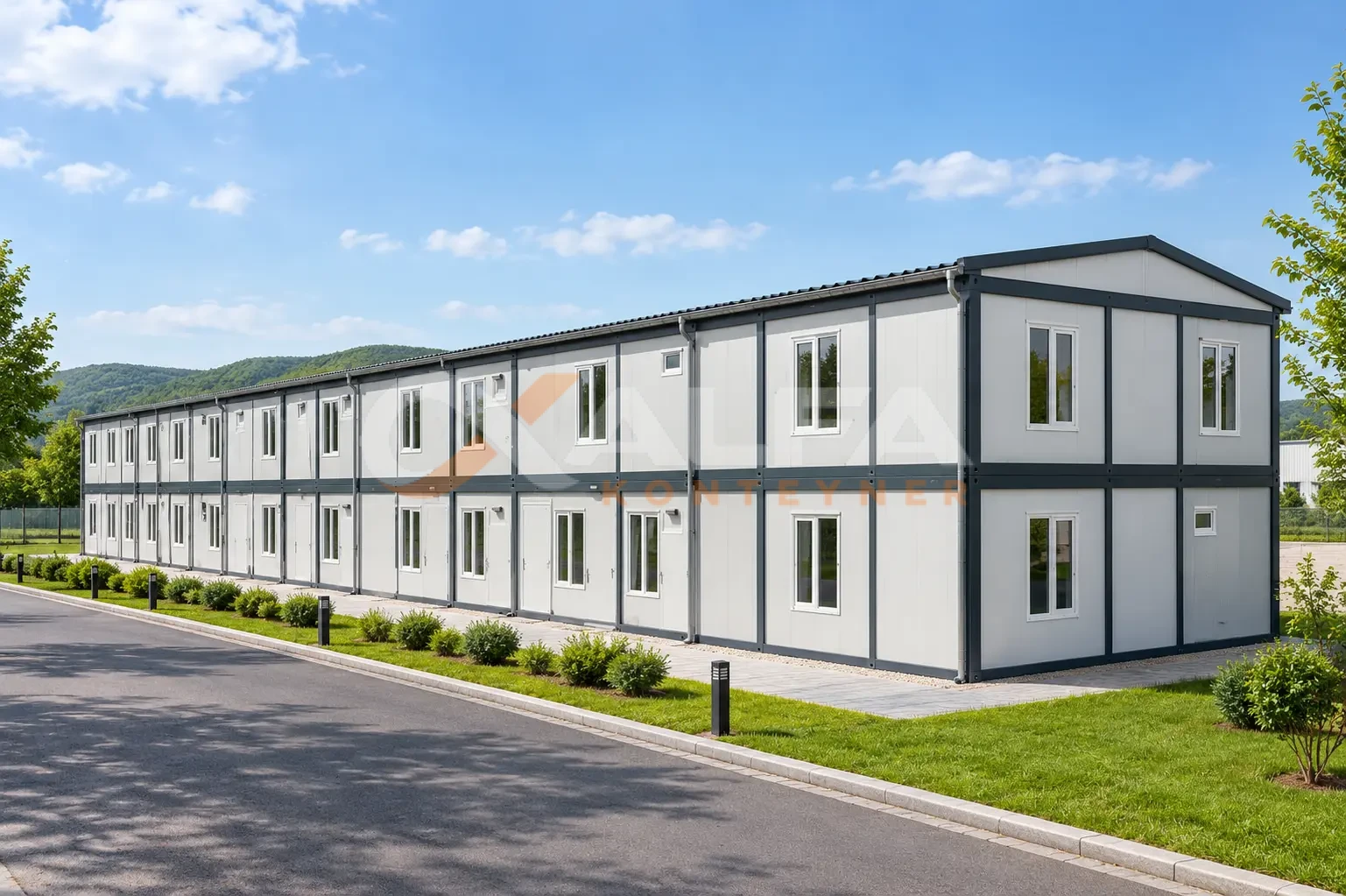
Flat-Pack Containers: Shipped in Packs, Assembled on Site
Thanks to their bolted, weld-free galvanised frame, these containers are taken apart, shipped in packs, assembled on site and, when needed, dismantled and moved to a new site. We manufacture them in our factory in Kocaeli, Türkiye.
A container that is easy to transport and can be re-assembled
What is a flat-pack container?
A flat-pack (knock-down) container is a modular building whose base frame, roof frame, corner posts, wall panels, doors and windows are manufactured separately at the factory, shipped in packs and bolted together on site. Once assembled it offers the same usable space as a monoblock container, and when the project ends it can be dismantled and re-assembled on another site.
Most of what you pay to transport in a container is air: a monoblock container takes up its full volume on the vehicle even when it is empty. In a flat-pack container the panels and frame members are packed on top of each other, so more modules fit on the same vehicle, and narrow roads or sites that a crane cannot reach become suitable for installation.
Because our load-bearing system is designed as bolted and weld-free from the outset, our flat-pack containers are made with the same materials and technical standard as our monoblock models: a frame shaped from galvanised/galvalume sheet by laser cutting and press-brake bending, 50 mm polyurethane-insulated sandwich wall panels and a 40 mm polyurethane-insulated roof panel.
See the technical specificationsWhat parts make up a flat-pack container?
Every module is made from the same set of parts. The parts are packed in assembly order and joined on site according to the drawing.
- Base frameGalvanised profile floor frame. The 14 mm fibre-cement board and PVC floor covering are laid on top.
- Corner postsFour load-bearing posts that bolt the base frame and roof frame together.
- Roof frame and roofTop frame, closed with a 40 mm polyurethane-insulated capped roof panel and trapezoidal sheet.
- Wall panels50 mm polyurethane (PUR) insulated sandwich panels with a pre-painted galvanised steel surface in RAL 9002.
- Doors and windowsInsulated steel external door 920×2000; 970×1200 PVC window with 4+9+4 double glazing.
- FastenersBolts and connecting parts. The scope of electrical and plumbing work is specified in the quotation.
Flat-pack or monoblock?
Both shipping methods use the same materials and technical standard. The difference is how the container reaches the site and how much work is done there.
| Feature | Flat-pack | Monoblock |
|---|---|---|
| How it is shipped | As parts, in flat packs | Fully assembled at the factory, in one piece |
| Space taken up in transport | Little; more modules per vehicle | The full volume of the container |
| Work on site | Assembly of frames, posts, panels, doors and windows | Positioning and connections |
| Time on site | Longer, because of assembly | Shorter |
| Dismantling and relocation | Dismantled, repacked and moved | Moved in one piece by crane |
| Best suited to | Remote or hard-to-reach sites, export shipments, large numbers of modules | Nearby sites, fast commissioning |
How is a flat-pack container assembled?
Our installation crew assembles the containers according to the drawing. The duration depends on the number of modules and storeys and on how well the site is prepared, and is stated in writing in the quotation.
- Ground preparationThe ground under the container must be level and load-bearing; a concrete slab or concrete pad footings are the most common solutions.
- Base frame and corner postsThe base frame is placed on the ground and the corner posts are bolted to it.
- Roof frame and roofThe roof frame is set on the posts and the roof panel and covering are completed.
- Wall panels, doors and windowsSandwich panels are fitted in place; doors and windows are installed in the positions shown on the drawing.
- Installations and handoverElectrical and, where needed, plumbing connections are made; after inspection the building is handed over.
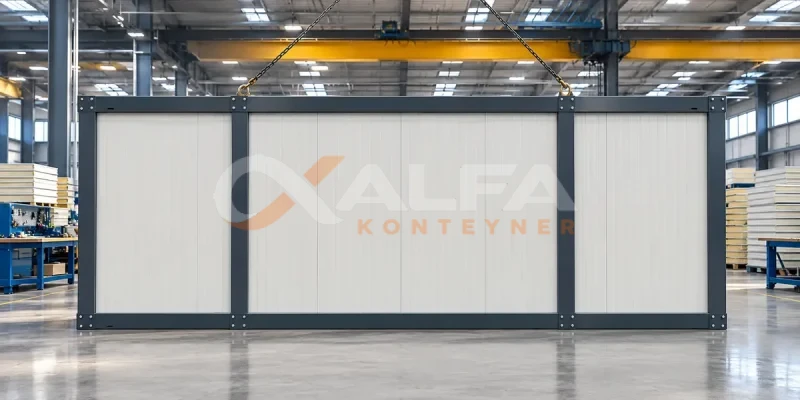
Watch a flat-pack container being assembled
See how a flat-pack container is put together on site with our bolted, weld-free system: from the base frame and corner posts to the roof frame, wall panels, doors and windows.
- Bolted joints, no welding on site
- Assembly order of the packed parts
- Ready-to-use module at the end

Flat-pack container models
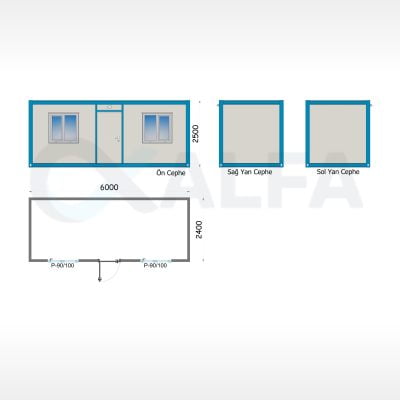
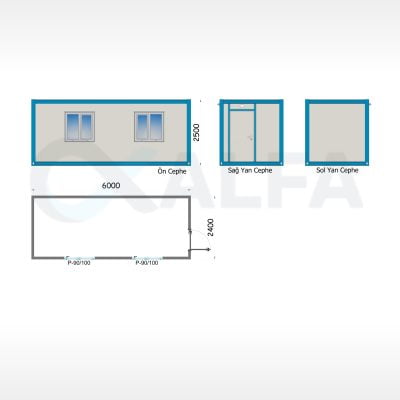
Our standard 240×600 cm (14.4 m²) modules can be shipped flat-packed. Interior partitions, door and window positions and wet areas are adapted to your project; for other sizes, we assess flat-pack shipping with you at the quotation stage.
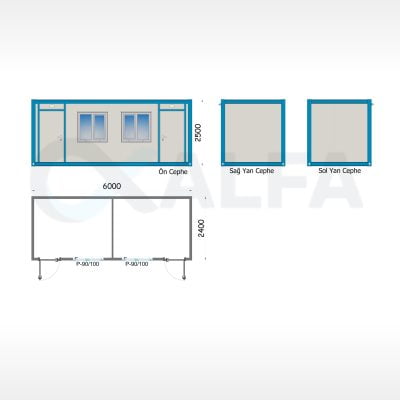
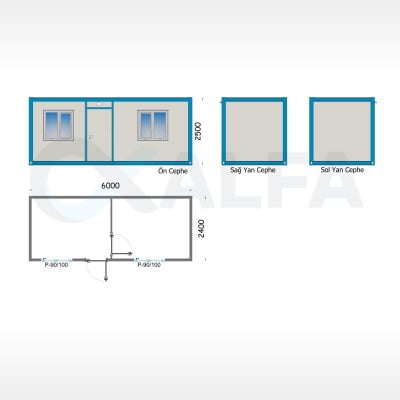
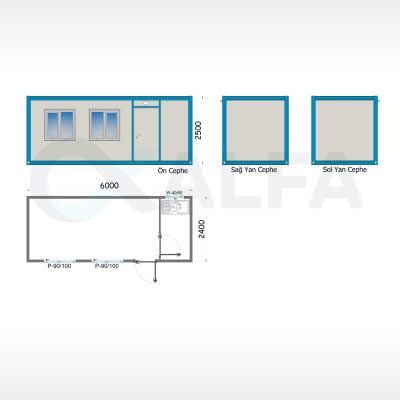
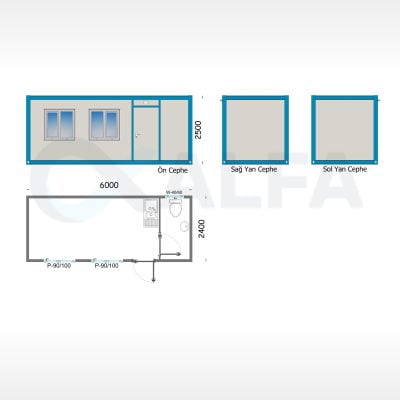
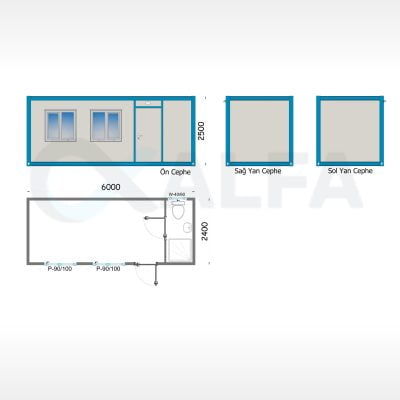
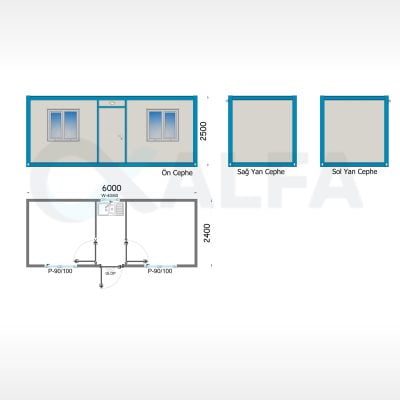
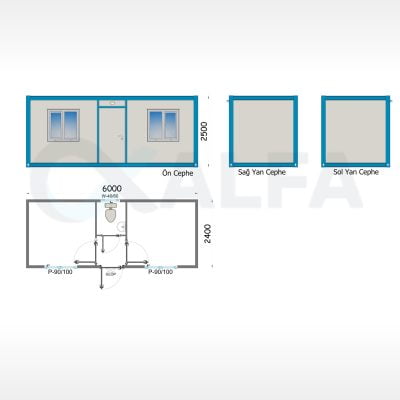
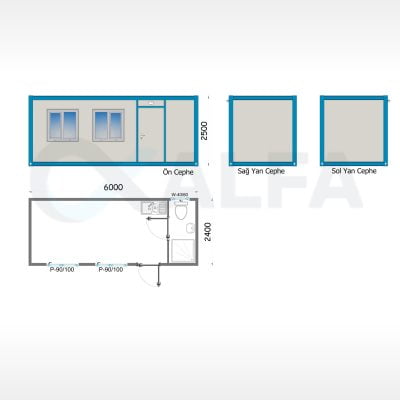
Where are flat-pack containers used?
Site and field offices
Offices used for the duration of a project and moved to the next site when the work is done.
Accommodation
Modules placed side by side or stacked to house staff on remote sites.
Site camps
Complete camps with office, accommodation, dining and WC & shower modules.
Security and sales points
Single-module buildings such as gatehouses, sales offices and information points.
Disaster relief and temporary shelter
Urgent needs where many modules must be shipped in a short time.
Remote sites and export
Long-distance and international projects where transport volume drives the cost.
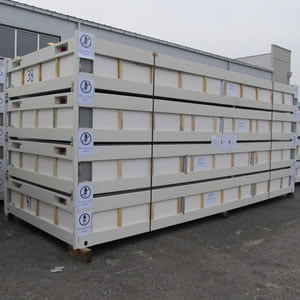
Shipped in packs, with less volume
The parts of a flat-pack container are packed at the factory in assembly order and loaded onto the vehicle. On site, the packs are unloaded and the module is assembled where it will stand. This makes back yards a crane cannot reach, narrow site roads and other hard-to-access locations suitable for installation.
On long-distance and international projects, flat-pack shipping helps lower costs by reducing transport volume. Shipping, insurance, delivery terms and on-site installation scope are set out in writing in the quotation.
- More modules per vehicle
- Installation possible where crane access is difficult
- Dismantled, repacked and moved to a new site
What to consider when buying flat-pack containers
We clarify these six points with you at the quotation stage.
Ground and vehicle access
The unloading area and the ground under the container must be prepared in advance. Let us know where the vehicle can pull up when you request a quote.
Number of modules and layout
How many modules will be placed side by side or stacked determines the installation time and the crew needed on site.
Partitions and wet areas
If you specify partitions, a WC & shower or a kitchen from the start, the panel, door and window set is prepared accordingly.
Utility connections
Electrical and water connection points are positioned according to the mains and wastewater lines on site.
Future relocation
If the building may move to another site later, dismantling and re-assembly are planned from the start.
Delivery terms
Shipping, insurance, delivery terms and on-site installation scope are set out in writing in the quotation.
About flat-pack containers
If you can’t find the answer you need, contact us directly.
Ask a questionWhat is a flat-pack container?
A flat-pack (knock-down) container is a modular building whose base frame, roof frame, corner posts, wall panels, doors and windows are manufactured separately at the factory, shipped in packs and bolted together on site. Once assembled it offers the same usable space as a monoblock container, and when the project ends it can be dismantled and re-assembled on another site.
What is the difference between a flat-pack and a monoblock container?
A monoblock container is shipped fully assembled, in one piece, and simply positioned on site. A flat-pack container is shipped in parts and assembled on site. Both are manufactured with the same materials and technical standard; flat-pack shipping takes up less space in transport, while a monoblock needs less work on site.
How long does it take to assemble a flat-pack container?
Installation time depends on the number of modules and storeys, the scope of installations and whether the ground is ready. We state the production, shipping and installation schedule in writing in the quotation.
Can a flat-pack container be dismantled and moved?
Yes. Thanks to the bolted system, a flat-pack container can be dismantled, repacked and re-assembled on a new site. We also support dismantling, transport and re-assembly.
Can flat-pack containers be stacked?
Yes. With a structure reinforced according to structural calculations, modules can be built on two or three storeys; multi-storey buildings are calculated as custom projects. Upper floors are reached by external stairs and balcony corridors.
Is a flat-pack container as well insulated as a monoblock?
Yes. Walls use 50 mm and the roof 40 mm polyurethane (PUR) insulated sandwich panels, and the windows are PVC with 4+9+4 double glazing. Materials and insulation values are the same as our monoblock models.
What determines the price of a flat-pack container?
The price depends on module size and quantity, partition and equipment choices, the scope of installations, transport distance and installation service. For a net price for your project, simply fill in the quotation form.
Do you rent out flat-pack containers?
No. Alfa Konteyner is a manufacturer; our flat-pack containers are offered for sale only.
Do you ship flat-pack containers outside Türkiye?
Yes. Flat-pack containers are shipped in packs from our factory in Kocaeli, which reduces the transport volume for long-distance and export projects. Shipping, insurance, delivery terms and on-site installation scope are set out in the quotation.
Let’s plan your flat-pack container project
Share the number of modules, the installation address and the intended use; we will prepare our written quotation, including the shipping and installation scope.